
Food forest
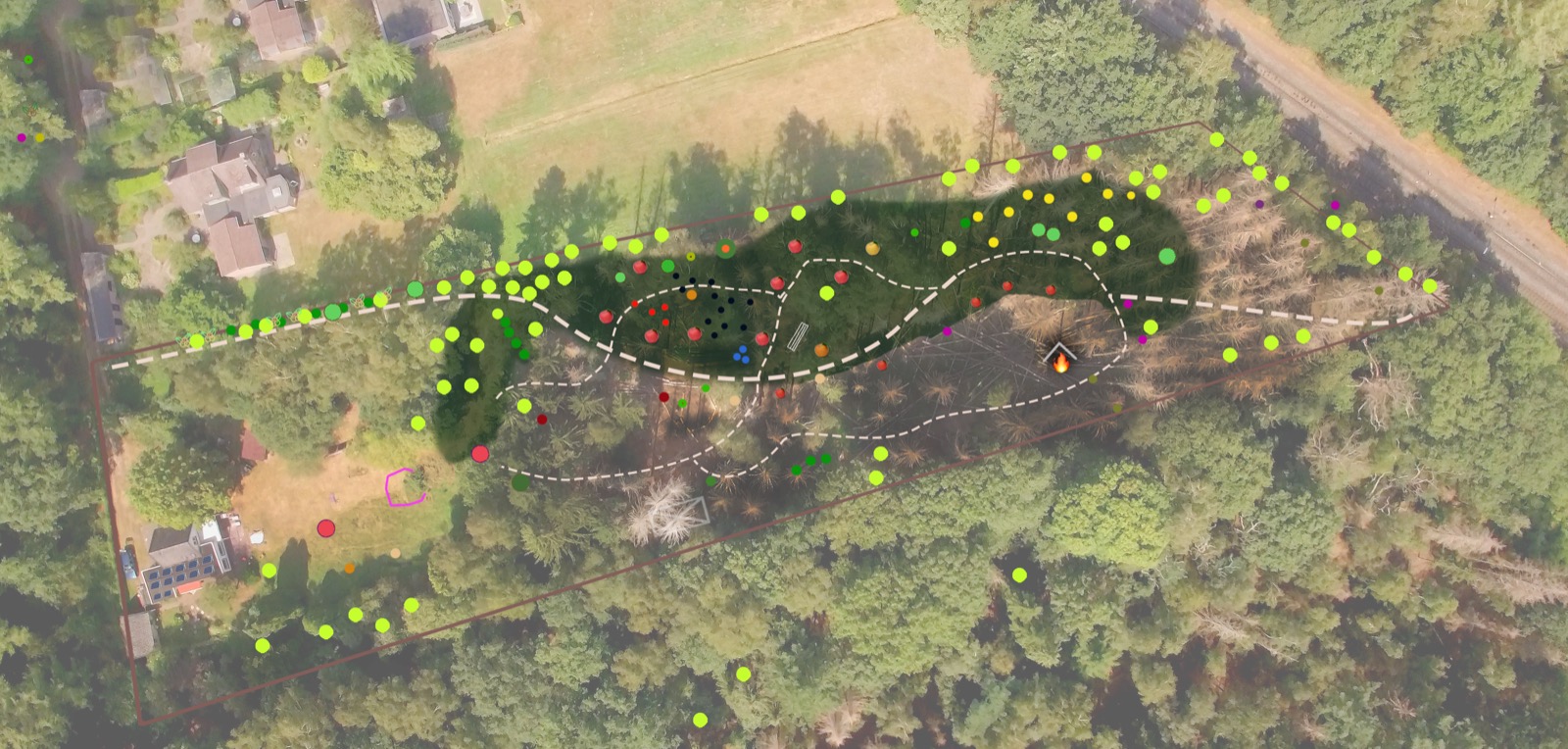
About a fifth of the land. Under development since 2020, on the spot where dead spruces stood.
How it started
For decades the back of the land held a dense Christmas-tree plantation of Norway spruce. In 2019 Thijs noticed that light was suddenly reaching places that had only ever been dark. A walk with the cat explained why: dozens of trees were dead. The spruces had not survived the droughts of 2017 and 2018 — no resin left to defend themselves against the European spruce bark beetle. Within a year we could watch the trains go by through the forest.
"Dead wood makes life" — that was the thought. In the second week of the coronavirus crisis, in 2020, Louis bought the forest. The idea: turn a dead pine field into a food forest, for people, animals and the biodiversity of the area.
What to do with all that wood
Around 250 trees were down. Most of them were felled with a chainsaw — by Thijs, sometimes with friends, sometimes with the whole family. Now and then a storm pushed a few more over. When some started falling towards the railway, two men with a machine came to steer the rest.
The market price for the timber that week was minus five euros: you paid to have it taken away. After long consideration we decided to leave it where it lay. The soil here is known to be poor and acidic — use what you have, work with it.
All the smaller branches went through a wood chipper twice. We use those chips for paths and to keep weeds down. The big pile of wood in the middle of the land has formed a natural divide ever since, between the wilder forest on the right and the more cultivated part (food forest, house) on the left.
Five principles
- Let nature do as much of the work as possible. No heavy machinery, no soil brought in or taken away, no fertiliser, no hoeing.
- Plant as competition for whatever establishes itself — not as a monoculture, but as a counterweight.
- Fair use for every plant. If something turns invasive, you cut it back.
- Build with what is already here. The dead wood, the wood chips, the existing soil.
- Take history into account. What would a wild Dutch forest look like if we hadn't spent the last 800 years felling it, grazing it bare, or filling it with pines?
What's growing (as of 2023)
More than 200 plants and trees planted, around 60 species. On top of whatever settles here by itself.
- Fruit trees
- 10 large + 10 small apple · 5 pear · 2 peach · 5 cherry
- Nut trees
- 3 walnut · 5 sweet chestnut
- Berries
- raspberries · strawberries · gooseberries · 10 redcurrants · Vaccinium
- Hedges / woodland
- 10 hazel · limes · dogwoods · beech hedging · elms · ash · alder · oak
- Ground layer
- herbs and herbaceous plants — whatever wants to be there
A food forest needs roughly 10 years to mature. This one is now (2026) in year 6.
Year 3 (2023) — what is it doing?
The third year was no longer about planting but about observing. "What is it still doing. Where is it going well, where badly. What survived."
The conclusion after year three: roughly 20% has a harder time every year and needs a hand. Usually something small — a little moat around the tree to hold water, correcting a badly chosen spot.
Most of the work turned out not to be planting but offering competition: cutting back whatever runs away with it. Birch, bramble, fern, rowan, Himalayan balsam, and a few old Christmas trees coming up again — leave them and they smother the food forest.
2024 – 2026
The steering phase continues. Progress per project is tracked in the private project log. What can be said publicly — walking through it now, six years after the first planting — is that the forest is settling in. Birds seek it out (flycatchers, woodpeckers, tits, nuthatches, treecreepers). Roe deer come over from the Appen forest on the right to graze. Most of the work is still cutting back what wants to establish itself for free.
Food forest versus the red-list edge
The food forest and the red-list forest edge lie next to each other but have different aims. In the food forest, edible non-native species are allowed (apples) and Vaccinium grows. The red-list edge is stricter: native red-list species only, and no Vaccinium there.
Path plan
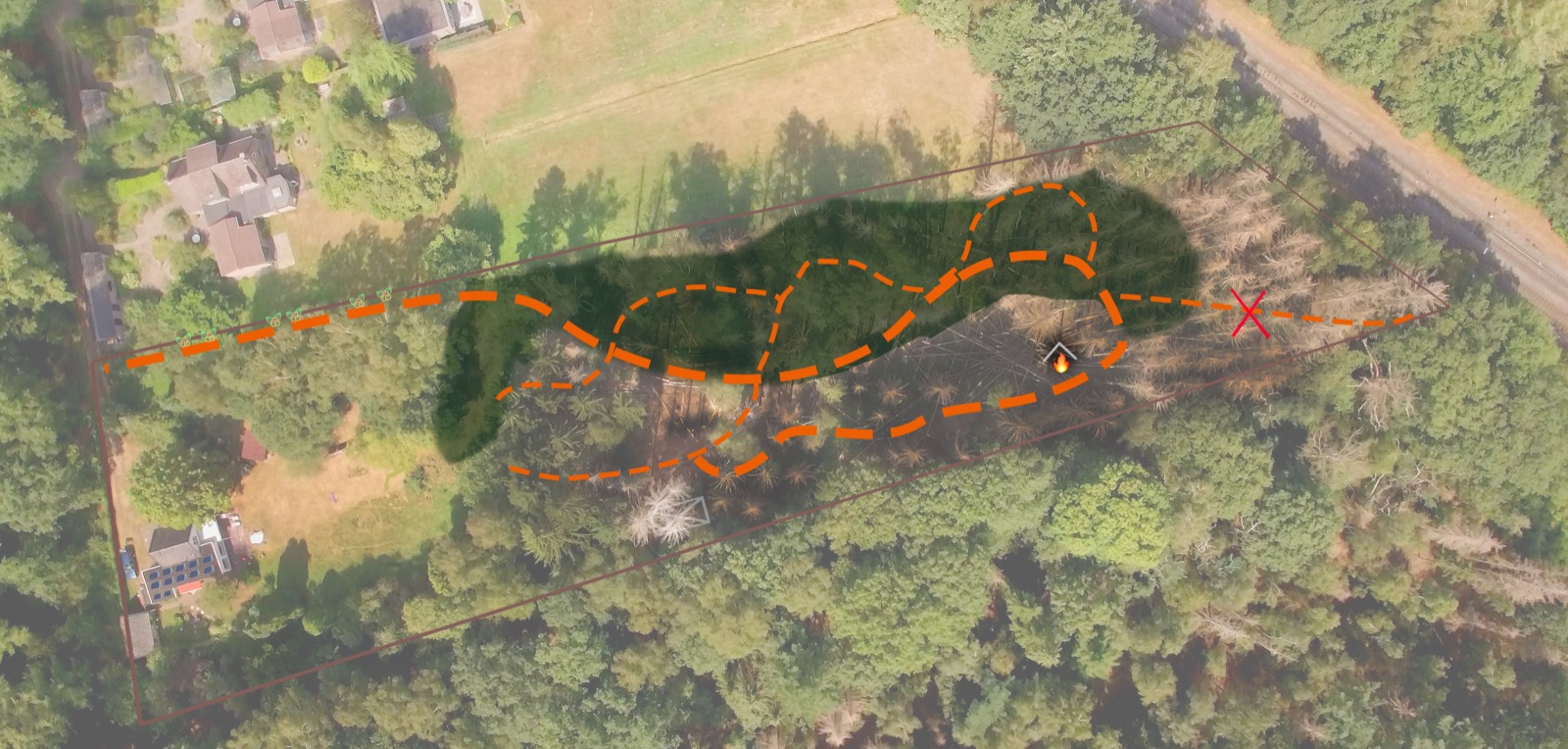
There is also an interactive map of the food forest showing where every tree, berry and fruit species stands. The species names on it are Dutch, with the Latin name alongside.