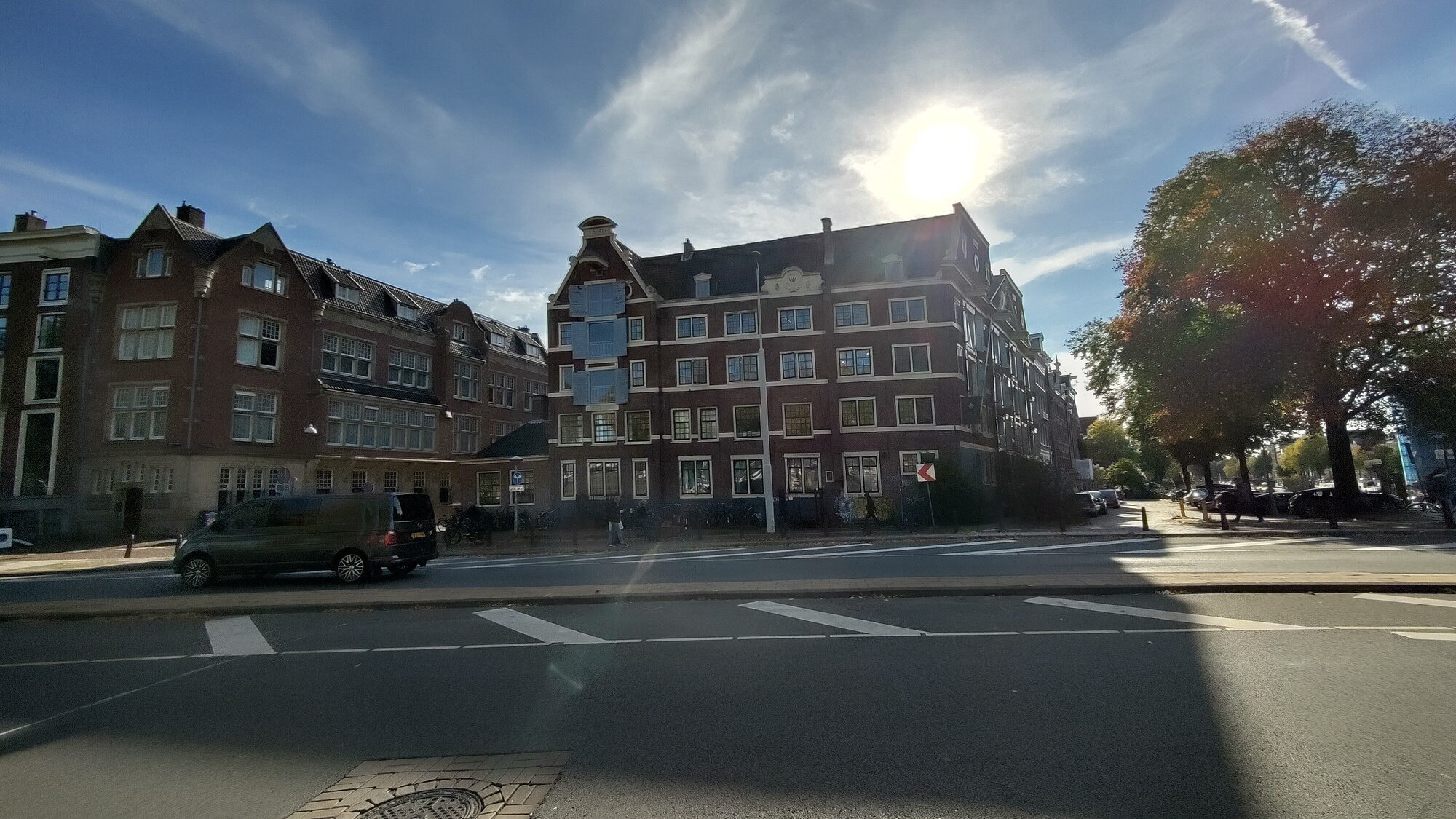
West Indisch Pakhuis
This is the West-Indisch Pakhuis, a 17th-century warehouse that carries the weight of global history. This building was completed in 1642, likely designed by the Amsterdam architect Pieter de Keyser. It stands here at ‘s-Gravenhekje, where the Oudeschans canal meets the Oosterdok. Back then, this was the bustling harborfront of Amsterdam, with an open connection to the so called Southern Sea, which gave access to the rest of the world. Back then, you’d be surrounded by shipyards and docks. Today, people live, work and play here.
Look up at the red-brown brick façade with its bands of natural stone. Between the two roof gables, you’ll notice a triangular pediment. In it are the large letters GWC – short for Geoctroyeerde West-Indische Compagnie, or the Dutch West India Company.
The West India Company was no ordinary trading firm. Its mission was both commerce and conquest: to dominate trade in the Americas and West Africa, to compete with Spain and Portugal overseas, and to secure profits from sugar, gold, and the transatlantic slave trade.
This warehouse was built to store the goods arriving from overseas, mainly beaver pelts coming from the Hudson Valley in modern New York State. On the ground floor, animal hides were pressed and stacked – many shipped across the Atlantic from New-Amsterdam, the small Dutch colony which is today’s New York City.
Because the colonies weren’t actually turning a profit, the company had to move its headquarters from the West India House into this warehouse. From 1647 until 1674 this warehouse doubled as the headquarters of the West India Company, with offices upstairs that are rented out still today.
From inside these walls, the directors managed their far-flung empire: from the sugar plantations in Brazil, to the fortresses on the West African coast, to Nieuw-Amsterdam itself – until it was captured by the English in 1664 and renamed New York.
In the early WIC years, silver raids and the Brazil sugar colonies were the biggest earners. There was some trade in gold, ivory, hides, and tobacco as well. But gradually, the trade in human beings became ever more important for the company.
Between 1623 and 1872, Dutch ships transported an estimated over 600,000 enslaved Africans across the Atlantic. Of these, about half a million were carried by the WIC or by private traders licensed by them. Mortality was staggering: on some voyages, 10–20% of captives died before even reaching the Americas.
Piracy was also a big part of the WIC. Like Piet Hein’s capture of the Spanish Silver Fleet in 1628, which brought in a single windfall larger than years of trade.
The main Dutch slave colonies were Curaçao (which became a transit hub), Suriname, the later Guyanas, and St. Eustatius. Curaçao alone saw tens of thousands of Africans disembarked before being sold onward.
Eventually, the colony in Brazil drained the treasury. Despite profits from slavery and gold, the company teetered on the edge of bankruptcy for decades. In 1674 it collapsed, only to be re-founded in a leaner form the very next year. The West-Indisch Pakhuis stayed in the company’s hands until the final dissolution of the second WIC in 1792.
This story sits on the map in the Free Amsterdam app, which walks you to the spot.
Open this story on the map