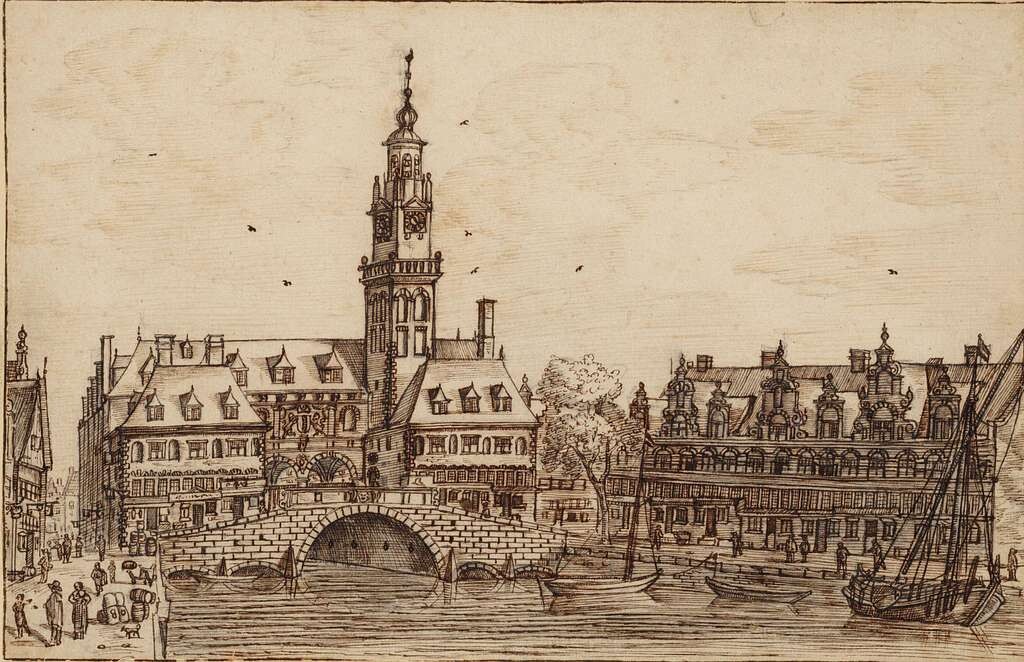
The first stock exchange
In the early 17th century, Amsterdam was not only the busiest port in Europe — it was also the birthplace of wild capitalist speculation, shares and a rudimentary stock exchange. For the first time in history, citizens could buy shares in a company, trading pieces of ownership that promised both risk and reward. This financial invention was as transformative as the printing press or the steam engine.
The Dutch East India Company, founded in 1602, was the first to issue stocks, based on forms of cooperation and risk management that had existed since the early days of Amsterdam. Instead of just relying on a handful of wealthy patrons to fund its voyages, the company spread the risk across thousands of investors. Each voyage to Asia was dangerous, but if one ship was lost, the others could still bring back spices, porcelain, or textiles. Investors shared in the profits, but also in the losses. This system of joint-stock investment allowed capital to grow on a scale never seen before.
What was truly novel was not just the idea of shares, but their tradeability. A permanent exchange was set up in Amsterdam where people could buy and sell stocks freely, creating a market in which prices rose and fell with expectations. Suddenly, speculation became part of daily life. Merchants, craftsmen, even widows invested their savings in shares of the VOC. The very idea of capitalism — money making more money through markets — was born here, alongside similar experiments in Britain.
But with new tools came new dangers. The tulip mania of the 1630s was the world’s first speculative bubble, when rare bulbs were sold for the price of a house. At its peak, fortunes were made and lost overnight, until the bubble burst. It became a cautionary tale that still resonates today whenever markets overheat, like in the case of crypto mania during Covid.
Amsterdam remained a global financial center for centuries. Its banks and stock market set the pace for Europe, and even today, after Brexit, many institutions shifted operations from London to Amsterdam, reaffirming its role as a hub of finance.
The Dutch have long balanced two sides of their culture in this story: de koopman en de dominee — the merchant and the preacher. Pragmatism and profit on the one hand, morality and restraint on the other. The stereotype of the Dutch as frugal — even gierig, stingy — reflects this same paradox. Capitalism itself was born from these tensions, in a culture that celebrated trade while preaching moderation.
From the first shares in the Dutch East India Company to the financial centers of today, Amsterdam’s legacy is clear: the stock exchange was not just a building, but a new way of seeing the world — where risk, reward, and speculation became part of everyday life.
This story sits on the map in the Free Amsterdam app, which walks you to the spot.
Open this story on the map