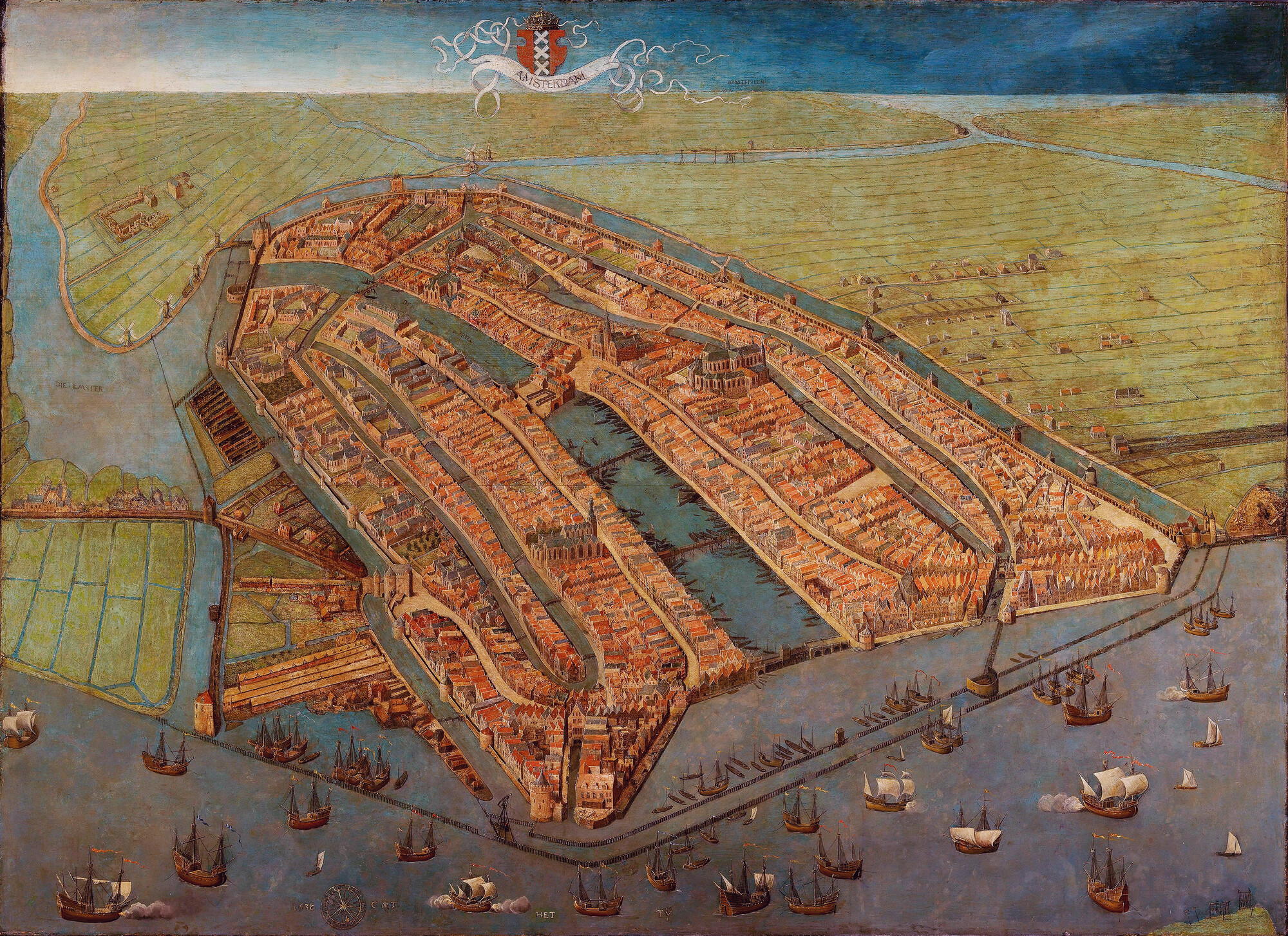
From fishing town to global city
This app will guide you freely through the history of Amsterdam as a city of possibilities, tolerance, and shortcomings. Amsterdam has always been a city where people did things their way, without being strictly tied to the morals of a single ruler, a dominant religion or a uniform ideology.
Live, let live, and exchange goods and ideas as you please… please. 🤞
Amsterdam, too, is beheld by the times it endured. So tolerating new ideas, divergent behavior and stranded newcomers has had its limits, like everywhere else. But in general, Amsterdam has had periods in its existence where it sprouted good, valuable, and lasting ideas for society.
Amsterdam’s beginning
Amsterdam is a relatively young city for Dutch cities, and didn’t begin until local counts started on water works in the area around 1200. The low, marshy lands around the Amstel River were drained and settled in the Middle Ages, with wooden houses built on piles driven deep into the ground. What started as a small fishing village grew by trading in herring — especially pickled herring, which could be exported across Europe. For centuries, fish sustained the town and tied it to the sea.
In 1275, the city received a toll privilege, and this is generally seen as the first official recognition of this new city: Amstelredamme.
Obviously, this was not the first time in history people had set foot in the marshy peat fields of the low countries. Humans have been in the Netherlands for many years since the last ice age, about 12.000 years ago. Around the place where Amsterdam had sprung, however, a large collection of urbanized provinces had sprung up that were starting to wield significant power in this Northwestern corner of Europe.
For the city of Amsterdam, the first great turning point came in 1345, when the so-called Miracle of Amsterdam took place. A sick man, unable to keep his down food, vomited a consecrated host into a fire.
Yet the wafer… did not burn. A miracle!
Declared a miracle by the church, the event turned Amsterdam into a site of pilgrimage. These pilgrims brought money, traffic, and renown, raising the city’s status within the Low Countries.
Then came the 17th century, what would be known as Amsterdam’s Golden Age - although I think there have been multiple bloom periods of Amsterdam, and I think we’re currently in one.
Amsterdam as a free city
Much can be said about the Dutch Golden Age. That it it didn’t last for a full century. That it brought misery to others through colonial wars, slavery, and exploitation - while it brought power, pride and picturesque gabled canal houses to its citizens and tourists today.
Amsterdam is as much a city of traders as of pirates, its wealth built both on commercial ingenuity and ruthless competition. The city became the hub of a global empire, with the VOC and WIC sending ships to Asia, Africa, and the Americas. At home, the canal belt was laid out, merchants’ houses rose, and Rembrandt painted his masterpieces.
The city slowed in the centuries that followed, but a second golden age arrived in the late 19th century. Industrialization and wealth funded sweeping expansion: the Central Station linked Amsterdam to the continent, the Rijksmuseum and Concertgebouw proclaimed a national culture, and the Paleis voor Volksvlijt (Palace of Popular Diligence) embodied civic ambition. Vast new neighborhoods were built outside the historic center, giving the city the shape we recognize today.
Amsterdam in the 20th century faced occupation, hunger, and rebuilding. The February Strike of 1941 marked a rare and courageous protest against Nazi terror, while the 1960s and 70s brought counterculture, squatting, and psychedelics, making Amsterdam once again a magnet for outsiders and dreamers.
Today the city remains both pragmatic and rebellious: a financial hub and a tourist attraction, but also a place of experiments, protests, and alternative communities. From peat and herring to canals and culture, Amsterdam’s history is the story of a small town that became a global symbol — of commerce, of freedom, and of contradiction.
This story sits on the map in the Free Amsterdam app, which walks you to the spot.
Open this story on the map