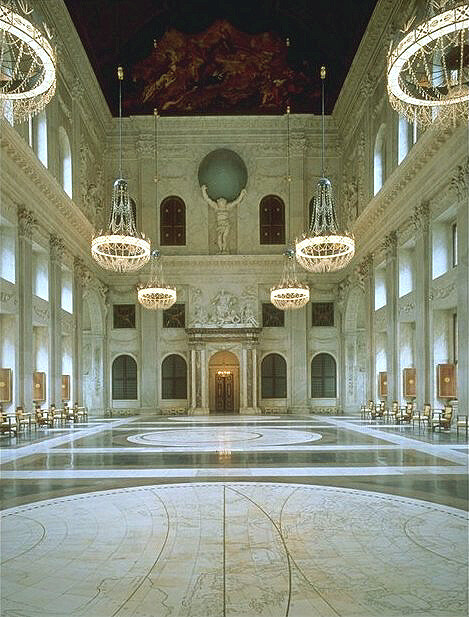
Paleis op de Dam ceiling
In 1980, the American astronomer Carl Sagan visited Amsterdam for the taping of his monumental series ‘Cosmos’. In episode six, he connect the modern journeys of the voyager spacecraft - past the planets and into interstellar space - to the voyages of Dutch explorers in the Golden Age.
The Amsterdammers of the Golden Age were so proud of their achievements in global trade, they saw themselves as the center of the world — if not the entire universe. Nowhere is this thought more apparent than in the Burgerzaal, the grand central hall of what was once the grand city hall of Amsterdam, located on Dam Square. Nowadays the building is in use as the Royal Palace. An unfortunate turn of events gave the symbol of the ‘Republic of Amsterdam’ to the royal family of the Netherlands.
Carl Sagan - the astronomer - was struck by how perfectly the Burgerzaal embodied the mindset of the Dutch Golden Age: Amsterdam literally placing itself at the axis of the world. For Sagan, the hall was both a celebration of human achievement and an expression of hubris - of a grandiose pride. He noted that every age imagines itself at the cosmic center — the Dutch Republic in the 1600s no less than ancient civilizations like the Greeks, Babylonians or Mayas.
Those who looked up to its vaulted ceilings would see more than decoration. The paintings, begun by Ferdinand Bol and Govert Flinck and completed after their deaths, are filled with mythological allegories. Gods and figures of the sea, of commerce, of justice — all encircle and legitimize Amsterdam’s rise as a global capital.
In one vault, Apollo drives his chariot of the sun across the sky, a symbol of cosmic order, suggesting that the city’s governance was aligned with the harmony of the heavens. In another, Amsterdam herself appears as a crowned figure of Victory, receiving riches from Mercury, god of trade, while the four continents — Europe, Asia, Africa, and America — approach with gifts. The seas, too, are shown in service: Neptune and his tritons pay homage to the city’s naval power and mastery of overseas commerce.
And while the heavens stretched above, the marble floors below carried vast world maps and a celestial chart, created by the famed Blaeu family of cartographers. Visitors quite literally walked across the mapped earth, while above their heads the order of the cosmos was displayed. Together, floor and ceiling created a powerful stage: earth below, heavens above, and Amsterdam in between — the point where both worlds meet.
The symbolism was unmistakable. To step into the Burgerzaal was to feel that Amsterdam was not just a city, but the political and moral heart of the world, framed by the universe itself. Modern science, Sagan reminded us, shows that we are of course part of a much larger and humbling universe.
In short, the Burgerzaal is a cosmic theatre. Its ceilings and its floors work together to proclaim Amsterdam as the center of the planet, the center of the heavens — and, at the same time, they remind us of a timeless human tendency: to place ourselves at the center of everything we see.
Nowadays, there is still a slumbering feeling amongst Amsterdammers that the Royal Palace should be given back to the city, and should once again feature as at least the symbolic city hall of Amsterdam. Calls for this ring out every now and then. The problem? Right now, the national government in The Hague pays for the building. If the city would get it, it would mostly get a great wedding location, but would also have to pay top euro to upkeep the building. The wish is more sentimental than sensible.
This story sits on the map in the Free Amsterdam app, which walks you to the spot.
Open this story on the map