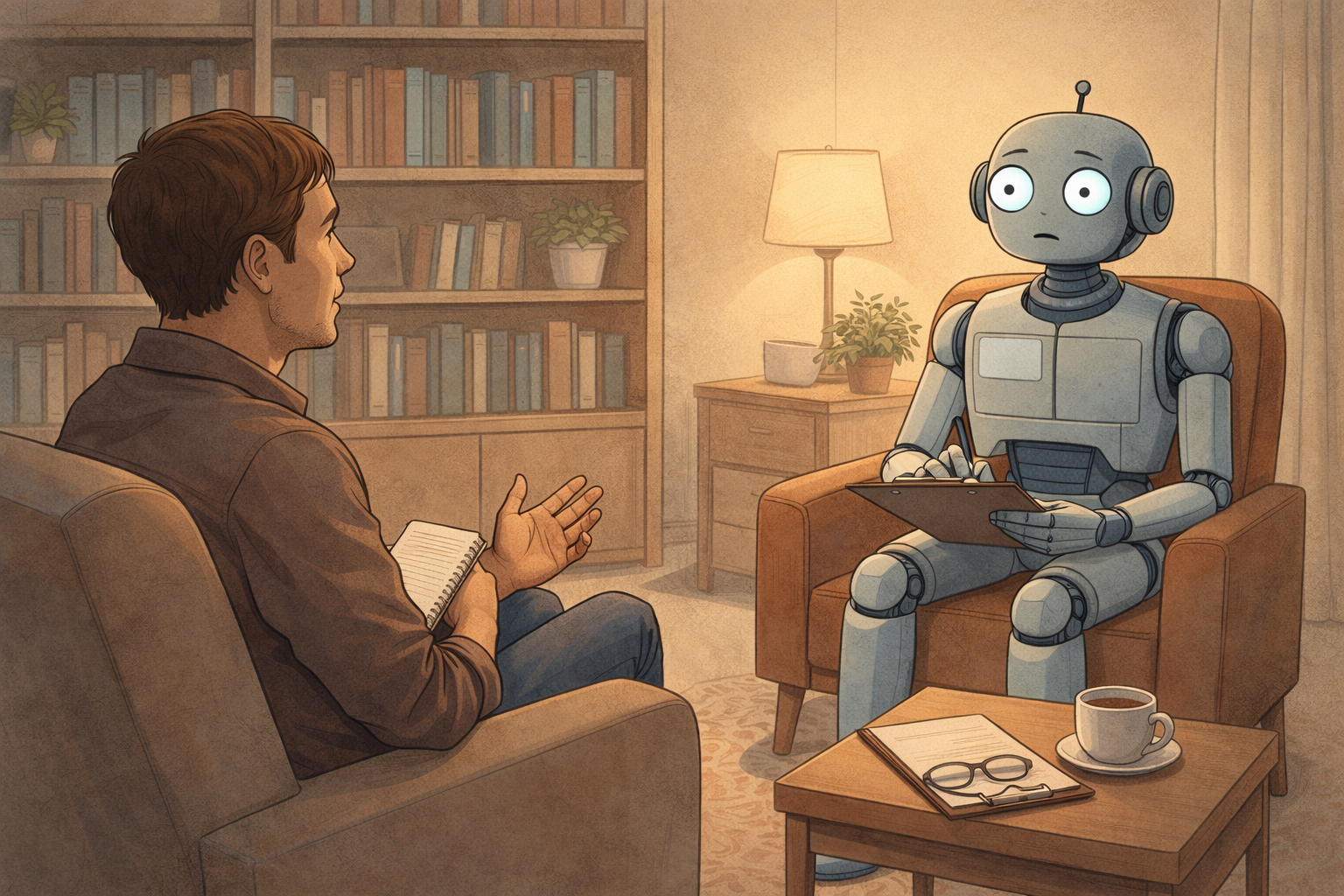
The past few years I’ve had to stare into the hollow abyss of existence quite a few times. While I’ve relearned the value of friendship and was taken somewhat aback by the barriers towards some professional help - I learned how to use and appreciate different AI chatbots to help me do my homework.
As psychological help is now the major use of AI bots outside of work-related tasks, I thought it would be a good idea to write down some of the lessons I’ve learned about these bots along the way. As they often surprised me in how much they mirrored my emotion instead of calm me down, or how they still can come up with silly answers.
1. Keep thinking for yourself
I’ve encountered multiple occasions in different chatbots where the bot had the tendency to move towards isolation in its responses. Sometimes, when uttering frustration into the chatbox, its response would be equally angry or assertive - not necessarily framed in such a way to restore connection or trust, but to mostly assert how right I am and how far ‘the other’ is removed from where you are. It will default to drawing boundaries, not to restoring connection.
2. You’re not handing over all your puzzle pieces
You will be unable to feed the AI your blindspots. The LLMs might help you locate your blindspots, but by definition, it’s really hard to give words to your personal unknown unknowns. If you’re not telling the bots that you kicked your dad in the scrotum before he called you a worthless piece of poo, the bots are going to give an unfair response to your whining.
3. Use multiple bots
No language model is the same. Using Gemini, Claude and ChatGPT will give you broader results. You’ll be surprised how different their flavour and insights are.
4. Correct it according to your values
The consequence of rule number 1, is that you have to keep looking at the bot results and compare them to your own values, perspective, experience, facts. Be stern, give it instructions on what your goals are.
You are absolutely right to correct me on this. I went too much into "defense mode" with you, causing me to lose sight of the nuances of your shared history and the need for a healthy understanding. That is indeed dangerous. Thank you for keeping me on my toes. - ChatGPT after a correction on values
5. Choose its tone or character
Ask it to be a stern friend or a warm mother - it depends on what you need at that moment. If you wake up with cold sweats at 4am and you don’t want to bother a human, there is no shame in asking for a few words of comfort to see if it helps calm you down. If you’re wearing your analytical hat later, you can ask it for clear and concise instructions on how to dig yourself out of your hole.
6. It still creates AI slob - but text
Train yourself in spotting hallucinations, mumbo jumbo and AI slob. All AI bots I’ve tried still come up with it, despite promises that ‘soon’ they will not. Even a friend who tried to write this article right here, couldn’t prompt it, because AI is still terrible at writing - I find. In 2026, it still misses oomph, good humor, or proof badly or fantastically written pieces - that give pieces actual character.
7. Talk to real people too
Some of the most terrible advice has come from some of my best friends. But don’t lose sight of human reality, social interaction, the need for experiences to develop your emotions around the issue you’re dealing with.
Talking to AI bots can be incredibly great homework and comfort if you feel the need to work through some things. But it cannot be a replacement for real-world experience. Talk through your emotions with real people, like friends, therapists or random strangers who might have gone through something similar.